|
How
did the legend of "Santa Claus" evolve?
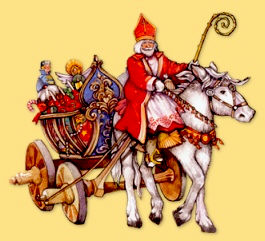
St.
Nicholas of Myra (Also called Nicholas of Bari)
The Santa Claus legend can be traced back hundreds of years to a monk named
St. Nicholas.
It is believed that Nicholas was born sometime around 280 A.D.
in Patara, near Myra in
modern-day Turkey. Much admired for his piety and
kindness, St. Nicholas became the
subject of many storiess. Nicholas was a
very generous man, known for his charity and
wisdom, who gave away his wealth
to those in need. He would often go out at night, disguised
in a hooded cloak,
to leave gifts of money, clothing or food for the poor and underprivileged.
Over the course of many years, Nicholas's popularity spread and he became known
as the
protector of children and sailors. His feast day is celebrated on the
anniversary of his death,
December 6. This was traditionally considered a
lucky day to make large purchases or to
get married. By the Renaissance, St.
Nicholas was the most popular saint in Europe.

Dutch
"Sinter Klaas"
St.
Nicholas made his first inroads into American popular culture towards the end
of the
18th century. In December 1773, and again in 1774, a New York newspaper
reported that
groups of Dutch families had gathered to honor the anniversary
of his death. The name Santa
Claus evolved from Nick's Dutch nickname, Sinter
Klaas, a shortened form of Sint Nikolaas
(Dutch for Saint Nicholas). In 1804,
John Pintard, a member of the New York Historical Society,
distributed woodcuts
of St. Nicholas at the society's annual meeting. The background of the
engraving
contains now-familiar Santa images including stockings filled with toys and fruit
hung
over a fireplace. In 1809, Washington Irving helped to popularize the
Sinter Klaas stories when he
referred to St. Nicholas as the patron saint
of New York in his book, The History of New York.
Clement
Clarke Moore wrote a long Christmas poem for his three daughters entitled,
"An Account of a Visit from St. Nicholas." Moore's poem, which he was
initially hesitant
to publish due to the frivolous nature of its subject,
is largely responsible for our modern
image of Santa Claus as a "right
jolly old elf" with a portly figure and the supernatural
ability to ascend
a chimney with a mere nod of his head! Until
recently it was believed that this ballad was written in 1822 for Clement Clarke
Moore's daughters, and later anonymously published in the Troy [New York] Sentinel
on
December 23, 1823. But in 2000, Don Foster, in his book Author Unknown:
On the Trail of
Anonymous was able to demonstrate that Moore could not
have been the author.
Foster concluded that it was probably written by Major
Henry Livingston Jr. For
another analysis of the authorship see
Christmas
(Moore or Less?). Nevertheless,
"An Account of a Visit from St. Nicholas," created a new and immediately
popular American icon. In 1881, political cartoonist Thomas Nast drew on Moore's
poem
to create the first likeness that matches our modern image of Santa Claus.
His cartoon,
which appeared in Harper's Weekly, depicted Santa as a rotund,
cheerful man with a full,
white beard, holding a sack laden with toys for
lucky children. It is Nast who gave Santa his
bright red suit trimmed with
white fur, North Pole workshop, elves, and his wife, Mrs. Claus. 
Italian
"La Befana"
18th-Century
America's Santa Claus was not the only St. Nicholas-inspired gift giver to make
an appearance at Christmastime. Similar figures were popular all over the world.
"Christkind"
or "Kris Kringle" was believed to deliver
presents to well-behaved Swiss and German children.
"Christkind"
is an angel-like figure often accompanied by St. Nicholas on his holiday missions.
In Scandinavia, a jolly elf named "Jultomten" was thought to deliver
gifts in a sleigh drawn
by goats. English legend explains that "Father
Christmas" visits each home on Christmas
Eve to fill children's stockings
with holiday treats. "Pere Noel" is responsible for filling the
shoes of French children. In Russia on January 5, it is believed that an elderly
woman
named "Babouschka" visits Russian children leaving gifts at
their bedsides. In Italy, a
similar story exists about a woman called "La
Befana," a kindly witch who rides a broomstick
down the chimneys of Italian
homes to deliver toys into the stockings of lucky children.
~From:
HistoryChannel.com
Santa
Claus eGreetings
Send
Free Online Greeting Cards to your friends & loved ones.
ALL cards from 123Greetings.com
are absolutely FREE !!!
www.123greetings.com
|

 GET
OUR
GET
OUR